
Free market snapshot
Entering a new market? See whether there is demand, and what stands between you and the buyer’s money.
For a company taking a product into a new province, country or vertical, and for a founder testing an idea. Describe the product and the market. An AI model runs 24 to 60 searches (and more to check its findings), reads comparison pages, your competitors’ own websites and pricing pages, and the government pages that set the rules, then writes a PDF of up to four pages: a market test, who buys and what they require before they can buy, what is changing the market, who already sells it and at what published price, public signs of demand, entry risks, and the three questions only a full study can answer.
Free, by email — and not reviewed by a consultant. Your request is deleted after 7 days.
What the snapshot holds
Six parts, in this order, each claim followed by the id of its source.
Part 1
An executive brief and the market test
Three questions an idea test asks: do buyers show the need, do they already pay for this, and how hard is it to get in. Code answers each from the claims that passed every check (strong, some or little public evidence), never the AI. Then the situation, what complicates it, the question it raises and what the sources point to, and three key findings with what they mean for you.
Part 2
The market and its buyers
What the market is, the buyer groups and what each asks for, where they buy, what they use today instead, the job they hire this kind of product to do (Jobs to be Done, Christensen et al., 2016), and the licence, certification, rule or procurement step a buyer requires, marked when it comes from a government or standards body. Where the sources show none, the snapshot says so.
Part 3
What is changing, and the figures a sizing starts from
Two to four changes in the market (a rule coming into force, an incentive, a technology, a shift in what buyers do), each from sources of the last three years. Then up to three public counts a market sizing would start from, from official statistics, governments or research. The snapshot never estimates the size of a market itself. Last, what peer-reviewed studies (OpenAlex, with ScienceDirect journals first) and Harvard Business Review articles report about why buyers adopt, reject or pay for this kind of product.
Part 4
Competitors and their published prices
Up to five companies, each read from its own website, found through searches and through the comparison pages buyers read. Published prices are taken from their own pages, with the range across them. Brands that comparison pages name but the snapshot does not list are shown, so you can check what it left out.
Part 5
Demand, entry risks and the industry forces
News, programs, reports, buyer activity and peer-reviewed articles, each marked as money committed or interest stated, then two or three things that could slow a new seller, and Porter’s Five Forces (Porter, 2008): rivalry, new entrants, substitutes, buyers and suppliers, each rated high, medium or low only when its sources show it.
Part 6
Three questions it cannot answer
The questions about size, price and access that decide whether to enter. They are what a full study is for.
What it is, and what it is not
The snapshot is written by an AI model from public web pages and public statistics, then checked by code before it is sent. Nobody at Sagentix reviews it first; nothing from our own research library or from any client engagement goes into it.
- Every number and every web address in the snapshot must appear in the source it cites; a draft that fails is sent back once and then dropped.
- Competitors must cite a page we fetched from their own website.
- No verdict: the snapshot never says an idea is validated or viable, never estimates market size and never forecasts.
- The words you ask us to leave out are removed from the searches and checked again in the text.
- Counts, quotes and amounts are checked: “three competitors” must match the list, a quote must appear word for word in its source, and an amount keeps the currency its source gives.
- No claim that something does not exist: public sources can show who sells a product, never that no one else does.
- Every published price must appear, amount and currency, on that competitor’s own page; the price range is computed from those prices, never written by the model.
- A risk or change that names a law, regulator, licence or standard must cite a government or standards body; a sizing figure must come from official statistics, a government or research.
- Changes in the market, sizing figures and demand signals are searched again for an independent source: one a new source confirms is marked, and one a new source contradicts is removed.
- Each of the five forces is rated only when its cited sources show it, and a rating that contradicts the snapshot’s own facts (low rivalry beside four listed competitors) is withdrawn; the market-test answers are counted by code, never written by the model.
- A research finding must cite a peer-reviewed article or a Harvard Business Review article and match its abstract or summary; a study of another product, place or kind of buyer is dropped.
- A second AI model, not the one that wrote it, checks every item against its sources, and each item it rejects is removed.
- If no draft passes, you get a short note instead of a weak snapshot.
It is a starting point to check, not a market study.
Sample: practice management software for physiotherapy clinics
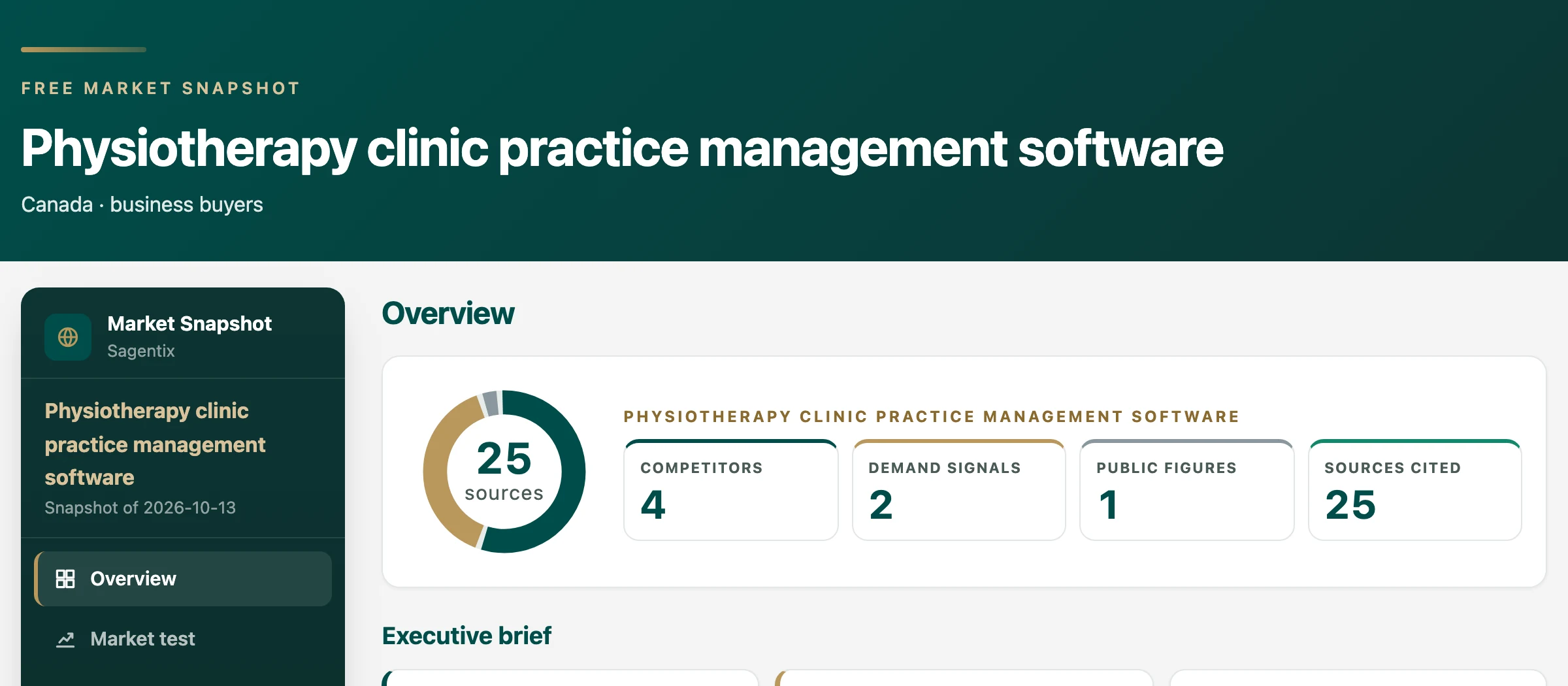
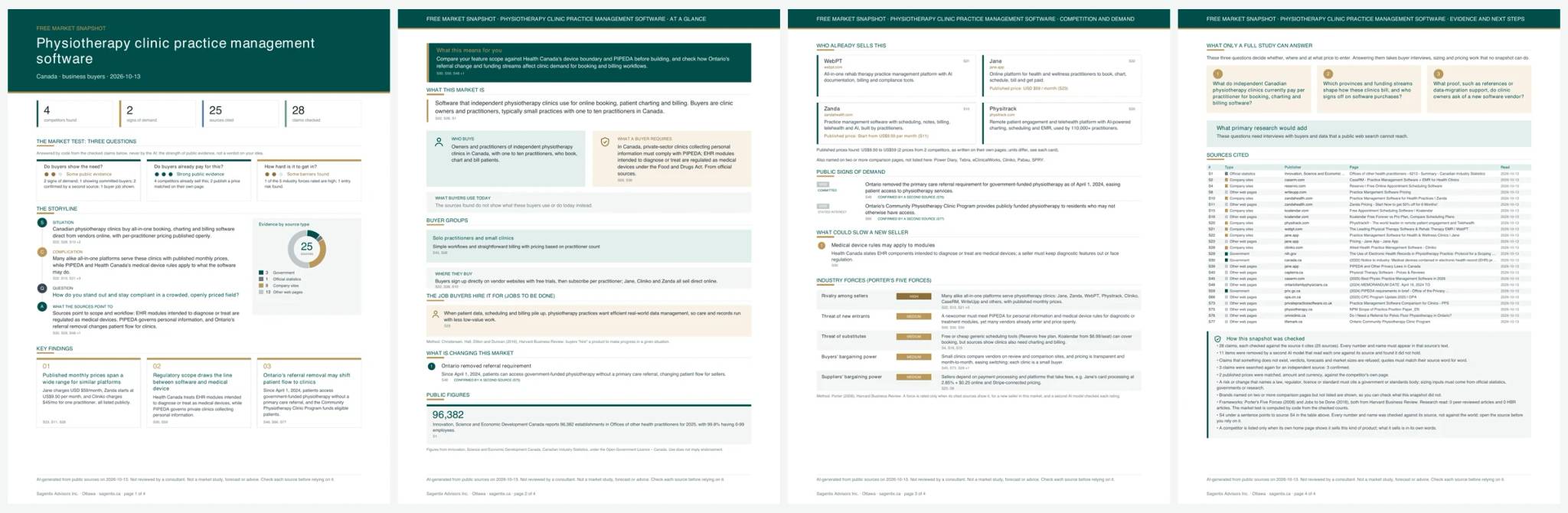
A software idea with no company named, Canada, business buyers, run on 13 October 2026: the top of the report, and the four-page PDF.
Same idea, two depths
We ran the sample idea above through Phase 1 on 13 October 2026. A free snapshot shows whether a market shows demand. Phase 1 finds the gate and sizes what sits behind it.
What stands between a seller and the buyer’s money is usually a gate — a licence, a payer’s billing channel, a procurement step or a certification. The snapshot names the gates public sources mention. Phase 1 maps them, prices the way through and tells you where to start.
Five to ten minutes · free
Free snapshot
- Four vendors that comparison pages name, two with a published price (US$9.50 to US$59 a month).
- The rules public sources name: PIPEDA for personal information, and Health Canada’s line between practice software and a medical device.
- The three questions that decide entry, left open on purpose.
Use it to see whether a market shows demand before you spend on it.
5 to 7 business days · CA$5,000
Phase 1
- Twelve vendors profiled, with the billing channels and prices each one publishes.
- The gate: the separate billing channels a full-service Ontario clinic has to reach to get paid.
- A sized market and a decision: where to enter first, and with which offer.
Use it when you are about to commit budget, people or a launch date.
What Phase 1 found that changes the decision
- 1
The money arrives through billing channels, each with its own rules
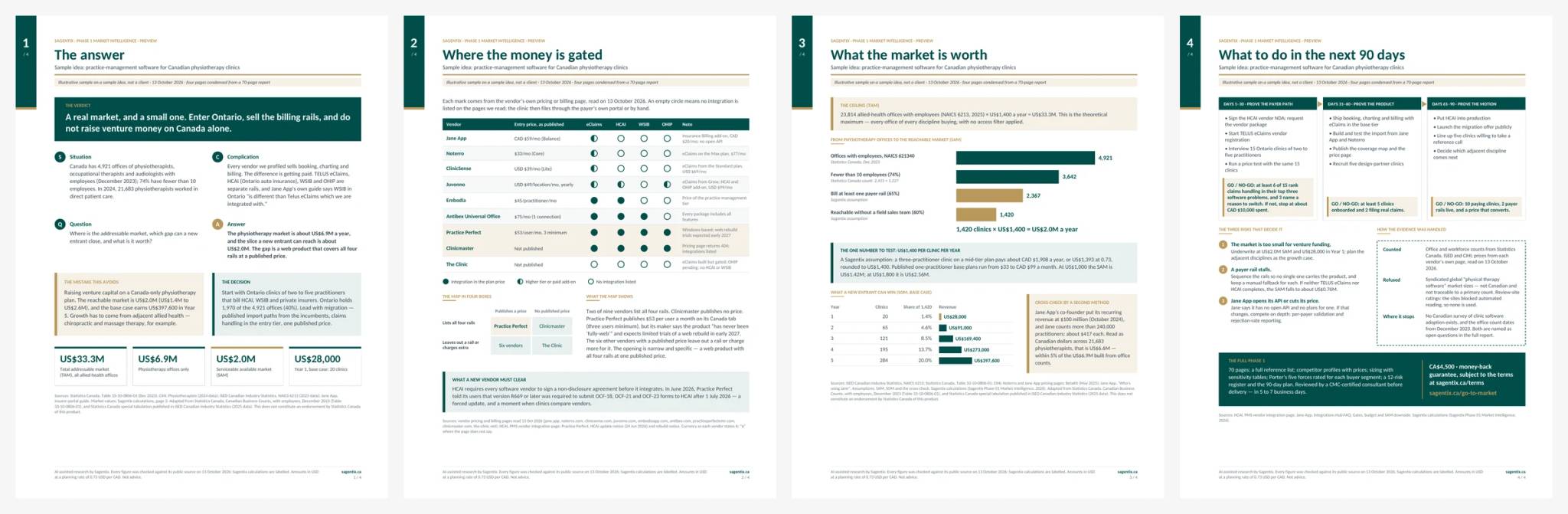
Clinics are paid by insurers as well as patients; each payer has its own channel. Ontario clinics bill workplace-injury claims to the WSIB through TELUS Health’s WSIB eServices (TELUS Health, n.d.). Auto-insurance claims go through HCAI, and Ontario’s accident-benefit changes of 1 July 2026 came with new versions of the treatment plan and invoice forms clinics submit (OCF-18, OCF-21 and OCF-23) (Financial Services Regulatory Authority of Ontario [FSRA], n.d.); one vendor told its clinics they needed its new release to keep submitting to HCAI after that date (Practice Perfect EMR, 2026b).
- 2
The open space: a web product for all four channels, at one published price
A full-service Ontario clinic bills four payers: OHIP, the WSIB, HCAI and, through TELUS eClaims, private insurers. Of the nine vendors whose billing pages Phase 1 read, two list all four, as published on their pages on 13 October 2026 (Sagentix Phase 01 Market Intelligence, 2026). One publishes no price. The other lists all four in a plan at $53 per user a month on its Canada price list, three users minimum (Practice Perfect EMR, n.d.); its maker describes the product as dependent on Microsoft Windows and expects limited trials of a fully web-based version in early 2027 (Practice Perfect EMR, 2026a). That gap — a web product with all four channels at one published price — is what a new entrant can price against.
- 3
A size that changes the funding plan
Phase 1 sized the reachable market at US$2.0M a year across 1,420 independent clinics, with a plausible range of US$1.4M to US$2.6M (Sagentix Phase 01 Market Intelligence, 2026). At that size the product is a sound small business in Canada; venture-scale growth depends on moving into other allied-health disciplines. The first segment it named — Ontario clinics with two to five practitioners that bill HCAI, the WSIB and private insurers, reached with an offer built around moving their records across.
The Phase 1 preview
Four pages from this study: the answer, the billing-channel map, the sizing with its arithmetic, and the 90-day plan. The full study runs to about 70 pages.
Open the Phase 1 preview (PDF)When the decision is close, Phase 1 answers it.
A cited market study in 5 to 7 business days, from CA$3,750 at Focused depth, reviewed by a Certified Management Consultant (CMC), with a money-back guarantee at that depth, subject to our terms.
See Phase 1How long it takes
Two minutes to fill in, then usually five to ten minutes of research and checking: a timer shows each step while it runs, and the PDF comes by email. One snapshot per email address and per company each week.
Privacy and the AI model
Your request and your snapshot are deleted after 7 days, and the files you upload are deleted once read. Email addresses and phone numbers are removed before the AI model reads your text.
An AI model run by Fireworks AI reads what you write or upload, plus public web pages. You agree to this on the form before the request is sent; that acknowledgement (its text, the time, your email and IP address) is kept for 3 years as the record of your consent. The full notice, including the AI models used, is in the Privacy Policy.
Questions people ask before they request a snapshot
Is the snapshot really free?
Yes. There is no account and no payment. We send the PDF once to the email address you give; Stéphane Raby receives a copy and follows up only if you tick the box about our services.
Who writes it?
An AI model run by Fireworks AI, from public web pages, public statistics, peer-reviewed and Harvard Business Review articles, and what you write or upload, following two published frameworks: Porter’s Five Forces and Jobs to be Done. A second AI model checks each item against its sources and cuts any that say more, code checks every number, price and web address, and the key claims are searched again for an independent source before the snapshot is sent.
What should I leave out of the form?
Anything you could not make public: personal information, financial statements, board material or anything confidential. Email addresses and phone numbers are removed before the AI model reads your text, and the words you list under exclusions are left out of the searches and the snapshot.
Will it tell me whether to enter the market?
Not with a verdict. The snapshot never says an idea or a market entry is validated or viable, never estimates market size and never forecasts. It does test the move against public evidence: its market test shows how much evidence there is that buyers need it, already pay for it, and face barriers to entry, with the counts behind each answer. It ends with the three questions about size, price and access that only buyer interviews and sizing work can answer.
What can I upload?
Up to 3 files (PDF, Word, PowerPoint, PNG or text), 4 MB together. Most useful: a one-page summary, a product sheet, a public presentation, a price list or a list of competitors. The files are deleted once read.
Is the snapshot available in French?
Yes. The form, the snapshot and the PDF all have a French edition; ask from the French page and the snapshot comes back in French.
Start with your own market.
When the three questions matter, Sagentix Phase 1 answers them with buyer interviews, sizing and pricing work: a cited market study (typically 60 to 90+ pages) in 5 to 7 business days, for CA$5,000 at Standard depth. Phase 1 at Focused depth (CA$3,750, one question) carries a money-back guarantee subject to our terms.
Raising money on this idea? The Investor Readiness Screen runs an investor’s eleven checks on your company first, for CA$2,500 in 7 business days.
References
- Christensen, C. M., Hall, T., Dillon, K., & Duncan, D. S. (2016, September). Know your customers’ “jobs to be done.” Harvard Business Review. https://hbr.org/2016/09/know-your-customers-jobs-to-be-done
- Crossref. (n.d.). REST API. Retrieved October 12, 2026, from https://www.crossref.org/documentation/retrieve-metadata/rest-api/
- Financial Services Regulatory Authority of Ontario. (n.d.). Changes in Statutory Accident Benefits coverage in Ontario on July 1, 2026. Retrieved October 13, 2026, from https://www.fsrao.ca/industry/auto-insurance/changes-statutory-accident-benefits-coverage-ontario-july-1-2026
- Innovation, Science and Economic Development Canada. (n.d.). Canadian Industry Statistics. Retrieved October 12, 2026, from https://ised-isde.canada.ca/site/canadian-industry-statistics/en
- Porter, M. E. (2008, January). The five competitive forces that shape strategy. Harvard Business Review. https://hbr.org/2008/01/the-five-competitive-forces-that-shape-strategy
- Practice Perfect EMR. (n.d.). Pricing [Canada]. Retrieved October 13, 2026, from https://practiceperfectemr.com/pricing/
- Practice Perfect EMR. (2026a, May 26). Practice Perfect EMR reimagined. Retrieved October 13, 2026, from https://practiceperfectemr.com/blog/practice-perfect-emr-reimagined/
- Practice Perfect EMR. (2026b, June 24). Upcoming July 1st, 2026 MVA HCAI/AISI changes. Retrieved October 13, 2026, from https://practiceperfectemr.com/blog/hcai-update-july-1-2026/
- Priem, J., Piwowar, H., & Orr, R. (2022). OpenAlex: A fully-open index of scholarly works, authors, venues, institutions, and concepts (arXiv:2205.01833). arXiv. https://arxiv.org/abs/2205.01833
- Sagentix. (2026, October 13). Sagentix Phase 01 Market Intelligence: physiotherapy clinic practice management software, Canada [Internal benchmark study, 13 October 2026; available on request].
- TELUS Health. (n.d.). Workplace Safety & Insurance Board (WSIB) services. Retrieved October 13, 2026, from https://www.telus.com/en/health/health-professionals/allied-healthcare-professionals/wsib
- U.S. Bureau of Labor Statistics. (n.d.). Quarterly Census of Employment and Wages. Retrieved October 12, 2026, from https://www.bls.gov/cew/